

Distributed-first companies are different from hybrid companies in one specific way: there is no office. Not a shared space that some people use sometimes, not a headquarters employees could visit if they chose. The ambient social contact that co-located teams accumulate passively (the hallway exchange, the overheard cross-team problem, the shared lunch between functions that creates trust useful months later) simply doesn't exist for fully distributed organizations. Distributed teams solve transactional collaboration well: async tools, documented decisions, regular check-ins. But the social capital that makes a team genuinely cohesive requires shared experience to develop, and that experience doesn't accumulate on its own when there's no office to create it.
Across 50+ countries and five years of distributed-team programs, we've designed and run more than 1,500 virtual team events for 300+ companies. The distributed-first clients that return for recurring events aren't coming back because the games are entertaining. They're coming back because a structured game event is the one mechanism in their People Ops stack that creates a shared reference point the whole company can point to months later.
Which virtual team building games work for distributed teams, and what specific mechanics make them effective when the team never shares physical space?
What distributed-first teams are actually missing
The deficit in distributed teams isn't skill, motivation, or even communication. Most distributed teams have highly functional async workflows. The deficit is incidental contact: the low-stakes social exchanges that co-located teams accumulate without trying. Research calls these "weak ties": not the deep professional relationships you build through sustained collaboration, but the cross-functional familiarity that makes the organization feel navigable. The colleague in Legal you've never worked directly with but know from the office kitchen. The designer in Berlin you've seen on enough video calls that a DM about something non-urgent feels natural.
Distributed teams don't accumulate weak ties organically. They have to build them deliberately. Virtual team events, the kind where small groups work through a problem together under narrative pressure, are one of the few mechanisms that generate weak ties at scale.
The mechanics that matter are specific. Breakout group work puts 4-8 people in temporary interdependence with colleagues they may rarely interact with otherwise. Coordination puzzles require real-time negotiation about who is good at what. Shared stakes on a leaderboard give teams a reason to celebrate with people they've never shared a celebration with before. These aren't abstractions. We see the cross-org DM threads that start after events, the Slack channels that form organically around a shared game narrative, the references to "the team that won" circulating in all-hands meetings months later.
A fintech team we worked with last spring (about 450 people, fully distributed across North America and Europe) had tried quarterly Zoom happy hours for two years. Turnout was declining and the People Ops lead was frank about it: the format was social maintenance at best and mandatory awkwardness at worst. After switching to a quarterly Marathon format, completion rate was 68% in the first event. More importantly, the People Ops lead reported something specific in our debrief call: team members who had never interacted on Slack before the event were noticeably more likely to show up in each other's channels in the three weeks after. The event had built the weak ties that the happy hours never reached, because the happy hours had no coordination mechanics, just a camera and a calendar block.
Big Game or Marathon: the format decision for distributed teams
The format choice sits upstream of the game choice for distributed teams, and it maps more directly to your team's specific structure than most organizers expect.
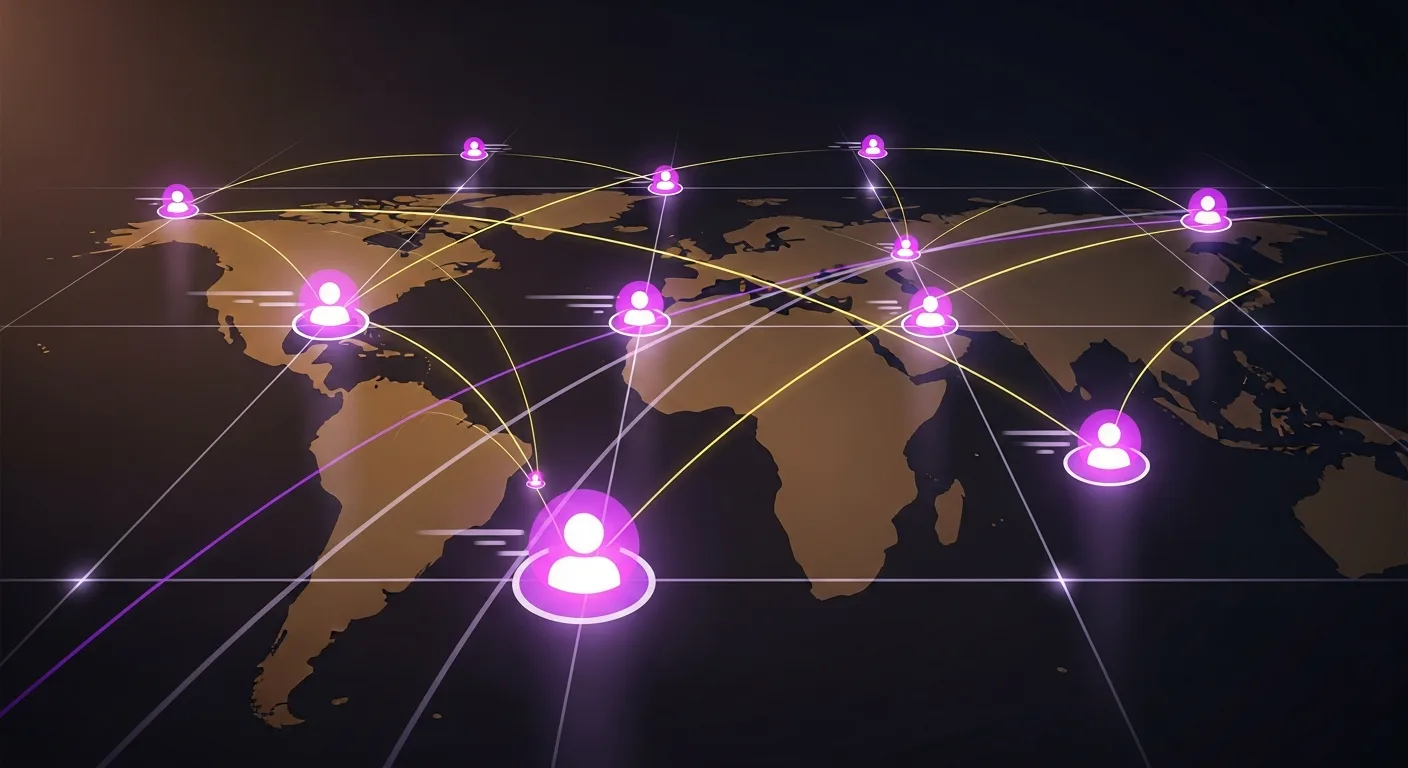
Big Game (a single live 60-90 minute synchronous event, hosted entirely by a HeySparko Game Host) works for distributed teams when you can find a genuine shared window. In practice that means a 6-hour or smaller time zone spread. US West Coast and US East Coast is easy. US East Coast and Western Europe is workable. Anything adding Asia-Pacific into a mix that already spans the Americas, or bridging more than 8 time zones, produces a window that disadvantages someone. The technical fact is that someone takes a 5:30am call or misses the event, and the social fallout from that inequality often outweighs the benefit of a shared live moment.
When the window genuinely works, Big Game is the stronger format for shared energy. The experience of watching a live leaderboard update while your pod debates a puzzle answer in breakout, the tension when a competing team submits something you haven't solved, the Slack explosion when your team cracks the final stage with eight minutes left: that doesn't translate to async. It requires everyone present simultaneously. For Mission 8-Bit, where the 90-minute three-act structure maps onto how technical teams think about quarterly project phases, that synchronous shared-moment energy matters particularly for distributed engineering teams running kickoffs.
Marathon (1-5 days of async daily game episodes, leaderboard-driven, no live host required) was built for distributed teams that can't or won't coordinate a shared window. Players engage when they want: the Singapore pod plays at 3pm local while the Austin pod plays at 3pm local, both contributing to the same leaderboard. We see 65-78% completion rates for opt-in Marathon events at 500+ companies, which routinely exceeds what forced-synchronous events produce for genuinely distributed teams. Roughly 35% of those completers are people who rarely or never show up to live events. The format reaches a segment of your team that synchronized scheduling systematically excludes.
For most distributed-first teams, the honest recommendation is to default to Marathon and reserve Big Game for moments when the synchronous energy is the point: a product launch, an all-hands celebration, a kickoff where the shared live moment matters in itself. For quarterly culture-building, Marathon's async design and multi-day story arc produce more sustained engagement than a 90-minute window you had to chase six time zones to find.
One more operational note for first-time organizers: the most common pitfall in Marathon events isn't the format, it's mid-event communication. A manager Slack message at Day 1 launch ("we're 6th out of 14 pods, let's move"), even a brief one, and a Day 2 note checking in on progress, lifts final completion rates by 15-20 percentage points over events that send a Day 1 launch email and then go quiet. The leaderboard creates pull; the manager creates urgency. Both are necessary for distributed teams where nobody's shoulder you can tap.
Six games that work for distributed teams
The six games below run in both Big Game and Marathon formats, making them flexible to your team's specific structure. What each game does for distributed teams differs by mechanic. Here's what matters for each.
Apocalypse puts teams in a post-outbreak race to develop and distribute a vaccine across four locations in 80 minutes before the last research lab falls. The specific mechanism that works for distributed teams: role specialization. By Stage 3, most teams have self-organized into specialists (logistics, synthesis, communications) without anyone formally assigning those roles. For a People Ops team trying to understand coordination patterns in a team whose manager has never observed them problem-solve in a room together, the analytics from an Apocalypse event are unusually informative. We've watched distributed engineering teams of 25 people surface their natural project leads and ICs in Stage 2's resource-management puzzle. The game makes the team's latent structure visible.
Last Temple Mystery is the flagship distributed game in our catalog. Four floors of Mayan temple puzzles (logic, observation, deduction) built on coordinate mechanics that don't require shared cultural reference points to engage. The mythology teaches its own symbolic logic as the game unfolds. In Marathon format, the floor-by-floor structure creates natural daily episode breaks that suit async play across time zones. For distributed teams between 100 and 1,000 players, it's the most consistently low-friction option we recommend.
Wintervald Hotel Mystery is an Agatha-Christie-style whodunit set in a snowbound luxury hotel. What it does for distributed teams that most other games don't: the deduction structure generates debate that continues after the event ends. The #general Slack thread about who the actual killer was, and whether the obvious suspect was a misdirect, runs for days post-event, pulling in team members who weren't in the same breakout group during the game. For distributed teams where cross-org familiarity is thin, those post-event conversations are relationship infrastructure in themselves. The game creates a reason for people who have never talked to each other to disagree productively about something that doesn't matter professionally. For teams that respond better to slow-burn atmospheric tension than parlor-style deduction, Book of Awakened Nightmares covers similar mystery-adventure ground with quieter intensity and an ensemble narrative structure.
Under the Big Top is a vintage circus mystery: a missing performer, a cast of wonderfully strange suspects, three stages of deduction across backstage tents and animal pens. Marathon format suits it particularly well. The multi-day investigation rhythm lets players develop and refine suspect theories between episodes rather than rushing a verdict. For distributed teams with international members, the circus aesthetic travels across cultures without requiring shared national reference points. Summer is its peak season but the investigation mechanic holds year-round.
Mission 8-Bit is the year-round choice for distributed engineering and tech teams. The three-act structure (escape the hostile office, rebuild a 1980s computer, enter the 8-bit digital world to assemble the killcode) maps onto how technical teams think about project phases: setup, build, ship. For a Q1 kickoff, the narrative arc creates a shared project metaphor that carries into real work. The 8-bit sprite versions of team members, delivered as a sheet post-event, become Slack avatars and internal swag, the shared artifact that keeps the event alive in daily team culture for months after.
Stolen Hours is the December option for distributed teams that want genre-bending imagination over holiday-themed parody. The chase across postapocalyptic, cyberpunk, steampunk, and biopunk worlds to recover Santa's stolen clock hands is Pixar-level stylized, not gory, and the premise doesn't center any single holiday tradition, making it one of the most globally inclusive year-end games in our catalog. For distributed teams with members across 12+ countries, that cultural neutrality is a practical advantage. The four worlds also surface different player strengths as teams move through them: some people shine in the gritty postapocalypse stage, others in the cyberpunk decode phase, creating natural role rotation that's especially useful for distributed teams whose members don't yet know each other's non-work capabilities.
What the data says about distributed team engagement
The research on distributed teams and engagement is consistent across sources, even when describing the same problem from different angles.
Microsoft's 2025 Work Trend Index (Breaking Down the Infinite Workday), based on a 31,000-knowledge-worker survey combined with Microsoft 365 telemetry, found that 30% of meetings now span multiple time zones — an 8-point absolute increase since 2021. For distributed-first organizations, that data point reframes the format decision: a third of all collaborative work is already happening across time zone boundaries that no single live event can comfortably bridge. Marathon's async daily-episode design is built precisely for that reality — players engage from their own time zone, contribute to the same leaderboard, and the People Ops lead gets a post-event analytics report broken down by team and manager. A manager whose pods span three continents can see which participated early versus late in their local day, where their team landed on the leaderboard, and which segment of their distributed roster engaged at all. That's intelligence they can't get any other way when they're not observing their reports in a shared environment.
Microsoft's 2024 Work Trend Index, which surveyed 31,000+ workers across 31 countries, found that 57% of distributed workers would prefer asynchronous engagement options over live ones. The operational implication for distributed-first HR teams is direct: design events for async by default and treat synchronous as the premium option for specific moments when live shared energy is the specific goal. Our Marathon completion rates — 65-78% for opt-in events — show what happens when that preference is respected rather than overridden.
Deloitte's 2023 Human Capital Trends report found that 46% of employees felt less connected to their colleagues than before the pandemic. For distributed-first companies, that disconnection is structural rather than attitudinal: without the ambient proximity of shared physical space, connections between team members decay unless something actively maintains them. A structured engagement event doesn't solve all of that, but it creates a shared reference point — "the week we all chased the vaccine" — that distributed teams don't otherwise accumulate organically, regardless of how strong their async communication practices are.
The academic literature supports building a program rather than running isolated events. Anog et al.'s 2023 systematic review of 60+ studies on team-building interventions, published through SSRN, found that structured team-building activities consistently increase satisfaction and reduce turnover, with effects amplified when integrated into a broader development strategy rather than treated as standalone events. For distributed teams specifically, that "broader strategy" framing is the strongest argument for recurring quarterly events over the annual one-off. The engagement signal compounds across a cadence in ways that a single December event doesn't produce — teams who've played before know the format, start strategizing about pod composition weeks in advance, and bring a social readiness to the event that cold-start first-timers don't have.
There's a financial argument too, for situations where leadership needs it. SHRM's 2024 cost-per-hire research puts the average cost of a non-executive departure at fifteen to twenty-one thousand dollars, including recruiting and ramp time. A quarterly engagement program that reduces voluntary turnover by even one or two points across a 400-person distributed team covers many multiples of its event budget. The math isn't complicated once it's laid out that way.
Frequently asked questions
What makes a virtual team building game work for a distributed team?
Three mechanics matter most for distributed teams specifically: breakout group work of 4-8 people, which forces temporary interdependence between colleagues who don't usually collaborate; coordination puzzles, which require real-time negotiation about who is good at what; and a shared leaderboard that gives the whole company a reason to compare notes across pods. These mechanics generate the weak-tie social connections that distributed teams don't accumulate through normal async workflows. Events without genuine breakout coordination, where everyone answers the same questions individually, miss this entirely and leave distributed teams exactly where they started.
How many people can join a distributed team building event?
Both HeySparko formats scale to 10,000 players. Big Game uses breakout teams of 5-8 with a shared Game Host and live leaderboard; groups above a few hundred split into competing squads on a unified leaderboard. Marathon supports any player count asynchronously, with the leaderboard mechanic creating competition across time zones without requiring anyone to be online simultaneously. In our experience, the practical range for most distributed-first teams is 50-1,000 players per event, though we've run Marathon events for global enterprises above 5,000 players. Below 50 people, Big Game typically provides stronger social density, since the breakout groups feel meaningfully competitive when there are enough of them.
Can a virtual game event replace a full team offsite for a distributed company?
Not fully. An offsite covers things a game event doesn't, including extended real-time collaboration, leadership visibility, and informal relationship time that spans multiple days in person. What a virtual game event does well is substitute for the shared-experience function of an offsite: it creates the common reference point and the relationship surface that in-person time normally generates. We typically see distributed-first teams use quarterly game events as the steady-state between annual or biannual offsites rather than as replacements for them. That cadence (offsite once or twice a year, structured game event every quarter) produces better sustained engagement than an annual all-hands with nothing in between.
What do the post-event analytics tell HR leaders about their distributed team?
Marathon format produces analytics broken down by team, by manager, and by event day: participation rate per pod, coordination signals, NPS pulse, and leaderboard trajectory across the event days. For distributed teams where managers don't directly observe their reports' day-to-day dynamics, this data surfaces team health patterns that don't appear anywhere else in the HR stack. A manager whose team consistently engages late in the Marathon window might have a time zone configuration issue that nobody has named. A team with high participation but low coordination signals might be playing individually rather than as a unit, a dynamics flag that's worth a conversation. The analytics don't replace judgment, but they make distributed team dynamics visible in a way that standard engagement survey data doesn't.
How do we choose games that work across the different cultures in our distributed team?
Narrative adventure and mystery games built on logic, observation, and coordination mechanics don't require shared cultural reference points, which is why they hold up across internationally distributed teams where trivia-format events often don't. The puzzle mechanics in Last Temple Mystery or Wintervald Hotel Mystery are culturally neutral even when the setting is stylized, because the challenges are deduction-based rather than knowledge-based. For December events specifically, Stolen Hours avoids centering any single holiday tradition, making it a reliable year-end choice for teams distributed across 10+ countries with different seasonal expectations.
How often should a distributed-first team run virtual team building events?
Quarterly is the cadence that produces compounding engagement in our data. Annual or biannual events create shared experiences but not a program. The social capital built in one event partially decays before the next one lands. Quarterly means four shared reference points per year, each building on the last. By the third or fourth event in a cycle, we see something specific: team members start strategizing about pod formation before the event launches, which means the game has become part of the team's culture rather than a vendor product the People Ops lead has to resell every time. That's the outcome worth targeting. Pricing and configuration options for recurring programs are at /en/pricing.